

Another Life: On Beauty and Justice
Art can serve as a means of envisioning a just future.


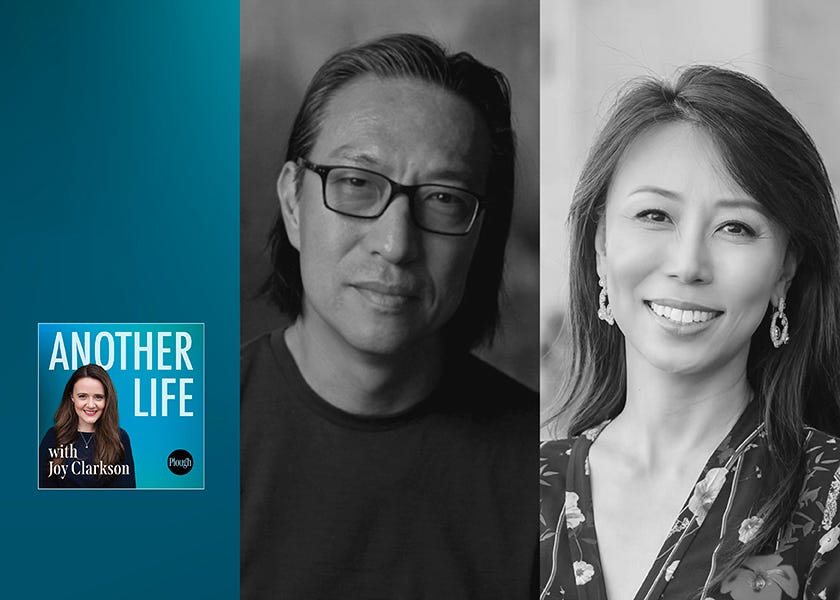
Hello, friends! And welcome new subscribers! For those of you who are new here, Plough has a podcast, Another Life, hosted by Joy Marie Clarkson ☀️. In this episode, Joy speaks with Makoto Fujimura and Haejin Shim Fujimura about beauty and justice.
This episode is part of the series built around to our Beauty issue: “The Call of Beauty.” Here are a two other episodes that might interest you:
Phil Klay on War:
Norann Voll on Lent in the Bruderhof:
A few highlights from the episode with Makoto Fujimura and Haejin Shim Fujimura:
On “Culture Care”:
Makoto Fujimura: I coined this term “culture-care” a long time ago as an artist navigating these fractures in culture to this day. “Culture wars” is the main metaphor and how we talk about culture as a battleground. And I thought that was not only unproductive, you know, you’re talking about destroying things and demonizing the other side and you’re pouring toxins into, poison into the very soil that you’re standing on. So really no one wins that way. You win by destroying something or someone. And that to me that didn’t really make sense. And the problem for an artist is that artists are always conscripted into the front lines. And we have to decide which side are we going to be on or at least straddle that way. And it’s not a very helpful metaphor, simply.
And I thought, well, as you noted, garden metaphor is so much better and ecosystem metaphor is so much better for culture because culture is an ecosystem. It’s a very delicate system that needs to be preserved, that needs to be advocated for, that has many, many complex elements operating simultaneously. So it is not black and white. It is prismatic. It is complex.
The connection between beauty and justice:
Haejin Shim Fujimura: Injustice is the brokenness of beauty, because injustice means there is some violence happening – exploitation or abuse or promises not met. People, creation, nature, or relationships have been broken. That is a state of injustice. Something that is supposed to be beautiful, that was created to be beautiful, has been damaged, and some wrong has been done. So in order for us to create justice out of that situation, we have to think about restoration of that beauty that was broken. So that interplay between justice and beauty, I think the more we talk about it, understand it, I think we can see the kind of justice that we envision together.
On being an artist and what art allows us to see:
Makoto Fujimura: Every time I come into the studio, I think about the privilege and this remarkable miracle that I get to do what I love and create portals into new creations through my work. Every time I get to exhibit them – I have an ongoing exhibit, a museum in Taiwan right now – I think about the total strangers coming into the museum and encountering these works. My prayer is that they not only see beauty manifested on the surface, but they see beauty beyond, to see beyond the surface, as a portal into new creation. And that’s the promise of art. Every enduring piece of art has this quality, whether religious or not; there’s something about art itself that manifests hope into the very language and material. And that’s why I think the arts fundamentally should be at the heart of education, because it allows students to see that there’s somatic knowledge of learning to craft anything – even making a salad, because that requires gardening and raising the vegetables and the slowness of how things grow, right? That has to be manifested in how we learn things, how we understand the world.
Any of that will point to a certain reality that makes us realize we are here to create, we’re here to make the future.
We hope you enjoy this episode!
Learn about Plough.
Subscribe to our magazine.
Browse our books.
Back in 2011, when the tsunami struck Japan, I was leading Christian relief efforts. The Japanese have many resources, so the early days of the crisis were muscular - incredible effort was put into rebuilding infrastructure. But the intangibles were much harder; the sense of hopelessness, isolation, loss that haunted everything.
Makoto came during that time and shared his artwork helping restore beauty in places where little was left but rubble.