


“Possibility is for the self what oxygen is for breathing,” wrote the philosopher Søren Kierkegaard. Meaning: when you can’t see a way forward for yourself or for the world, what you need is a sense that something new can happen, and that another life is possible.Welcome to PloughStack’s Possibilities.
Educational Decline
Graduation season is upon us. We are happy for the grads, but the state of education is dire.
New reporting from the Stanford Educational Opportunity Project shows a precipitous decline in reading and math scores in schools around America over the past ten years.
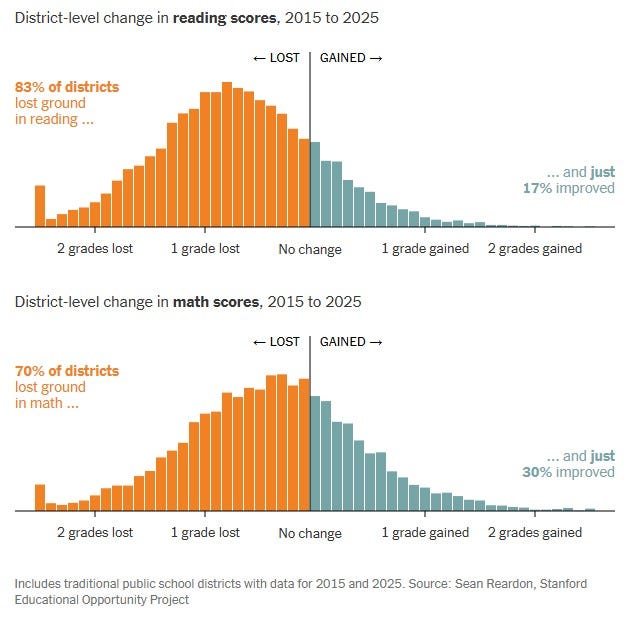
While the pandemic certainly had an effect, the New York Times pointed out that the decline began before 2020.
[M]any districts have experienced a long-term slump in student achievement, not just a blip during the pandemic. From 2017 to 2019, students lost as much ground in reading as they did during the pandemic, and reading scores continued to fall at a similar rate through 2024. Immediately after the pandemic, there was hope that students would recover quickly. The new data shows that scores inched upward in reading last year, and have climbed more steadily in math since 2022. But it has been nowhere near enough to make up for lost ground.
AI and Education
And now students are being hit with the AI revolution. A study from RAND shows that use of AI by middle and high school students is on the rise.
Between May and December 2025, the percentage of middle school, high school and college students using AI for homework rose from 48% to 62%. The increase was driven largely by middle and high school students, as use among college students remained relatively steady.
Because of the prevalance of AI, many teachers are having to reassess they way the assign work. As the New York Times reports:
In the era of artificial intelligence, take-home writing assignments have become so difficult to police for integrity that many educators have simply stopped assigning them. Instead, in a rapid shift, teachers are requiring students to write inside the classroom, where they can be observed. Assignments have changed too, with some educators prompting students to reflect on their personal reactions to what they’ve learned and read – the type of writing that AI struggles to credibly produce.
Universities are also affected. After holding to their “Honor Code” for 133 years, Princeton University will now require all in-person exams to be proctored.
The policy proposal cites AI and personal electronic devices as major catalysts behind the policy shift. “The ease of access of these [AI] tools on a small personal device have also changed the external appearance of misconduct during an examination,” it reads, making cheating “much harder for other students to observe (and hence to report).”
Fair seedtime had my soul, and I grew up
Fostered alike by beauty and by fear;
Much favoured in my birthplace, and no less
In that beloved Vale to which, erelong,
I was transplanted ...
— The Prelude by William Wordsworth
Is Educational Revival Possible?
It’s hard to get past the negative headlines, but this is the newsletter where we try to put forward at least one or two positive possibilities. So, here’s to trying.
How is education saved from this decline? With the challenges that come with AI, how do schools and educators forge a path forward?
One flourishing venture that we at Plough are proud to support is the Catherine Project. Each week, thousands of Catherine Project readers meet on Zoom or in person to discuss great works of literature, from Shakespeare, to Sophocles, to Confucius. As its founder Zena Hitz wrote in our pages four years ago:
In the world of institutional higher education, humanistic learning is ever more difficult to find. Perhaps it will help institutions to change their tune if movements like ours grow large enough. If they do not, we help to shape communities that do not depend on the university system alone for their intellectual engagement. Our studies benefit anyone, whatever their career path or lack thereof. Universities are wonderful, but they are not necessary in themselves for human flourishing.
Since its founding, the project has grown, with the help of over 300 volunteers, to offer over 950 courses, serving nearly 5,658 unique readers from over fifty countries. Blogger Matthew Yglesias is one of them:
I’ve never been a book club person…. Even when another friend put together a non-fiction book club, I dabbled for a few weeks and then dropped out. But last week, I attended my first meeting of an online reading group…. When I browsed the catalog over the spring, a lot of [the Catherine Project’s] offerings, frankly, sounded awfully daunting, but I did find an eight week seminar on Wuthering Heights…. I don’t know that joining reading groups about old books is the answer for everyone, but you ought to try something.
One thing Chat GPT cannot do is craftsmanship. Perhaps we need more trade schools teaching true craft that emphasizes quality and beauty. The American College of Building Arts (ACBA) does this. As Alex Sosler writes:
Rather than teach quick, easy processes with cheap materials, ACBA aims to train men and women to create and preserve beautiful, lasting structures. As you walk around its small campus underneath an overpass in downtown Charleston, you notice that the building is decorated with projects from students and professors. Architectural carpentry students made the entry doors. A chandelier made by blacksmiths hangs over the entryway. When I visited, students were working on a plaster installation. These final projects “proved” students belonged to the guild and could enter the workforce performing quality work worthy of respect.
The Bruderhof’s high school, the Mount Academy, offers similar programs for high school students. Alex Sosler continues:
The Mount Academy is not a technical school or prep school; it’s also not a music conservatory or athletic powerhouse. Yet it is all of these things. Its philosophy consists of “head, heart, hands.” It offers students opportunities to grow into their full human capacities and interests; its classes and clubs include welding, dance, agriculture, environmental science, art history, woodworking, and culinary arts. Students may read Plato or Shakespeare during the morning and then participate in a more hands-on activity in the afternoon, such as constructing a modular house for Habitat for Humanity in the school parking lot.
The College of Saint Joseph the Worker, a new school in Stuebenville, Ohio, looks to form students into “committed members of their communities by teaching them the Catholic intellectual tradition while training them in skilled and dignified labor.” The New Yorker’s Emma Green recently profiled them:
Students would take classes on subjects such as the New Testament, advanced geometry, and rhetoric, and earn a liberal-arts degree in Catholic studies. At the same time, they would specialize in one of four trades – carpentry, HVAC, electrical work, or plumbing – and work toward a certificate that signalled their expertise. The school was called the College of St. Joseph the Worker, named for Joseph, Mary’s husband and the patron saint of laborers.
Further Reading
The Liberating Arts: Why We Need Liberal Arts Education. A cohort of educators make the case for liberal learning.
Where Children Grow by Friedrich Froebel. The inventor of kindergarten offers wisdom on children’s education.
Plough-Share
Professor David P. Gushee reviews Plough’s The Memoirs of Andre Trocme, the newly translated diary of a French pastor who resisted the Nazis and offered sanctuary to thousands of Jews facing deportation to concentration camps.
As I contemplate this long memoir, what strikes me is that the primary through-line is not the rescue of Jews during the Holocaust, which occupied a relatively brief period of time in the life of André Trocmé. Even in the several chapters that deal with the war years, the rescue of Jews occupies a relatively small amount of the memoirist’s attention. It is as if it all occurs off-stage, and indeed, it did, by design — the Jews were hidden, secretly, in remote locations for the most part.
When Trocmé writes of the war years, we learn about so many other things, including pastoral struggles, issues with the local school, personality conflicts, family challenges, and local headaches. But above all we learn of the struggle to survive in a wartime environment first under collaborationist Vichy French officials, then under the thumb of the marauding Germans, then in prison, then back home but with the emergence of enemy paramilitaries, and then the rise of French resistance fighters (also quite dangerous), and then the chaos after D-Day, when it takes a scorecard to keep track of all the people with guns and all the stupid deaths.
This is a reminder that among the occupational hazards of studying the Holocaust is that one can tend to zero in so tightly on what the Nazis were doing to the Jewish people, or trying to do, in a given location, that you kind of forget everything else that was going on during a massive social and political and human crisis in the same place at the same time.
If one were to ask André Trocmé himself what his life was about, taken as a whole, it is clear that his answer would be his commitment to Christian nonviolence. Trocmé was constantly in trouble with someone — church authorities, political authorities, men with guns — because he would not hate whom everyone else hated, and he would not kill whom everyone else at that place and time said it was appropriate to kill. And he would not, as a pastor, allow anyone, from church or state, tell him what he could teach or preach about this or any other matter.
Read an excerpt from the memoir here.
Do you have any comments or questions – or new possibilities? Send them our way: