



“Possibility is for the self what oxygen is for breathing,” wrote the philosopher Søren Kierkegaard. Meaning: when you can’t see a way forward for yourself or for the world, what you need is a sense that something new can happen, and that another life is possible.
Welcome to PloughStack’s Possibilities.

Religion Is Still Declining
Despite recent news of a return to faith in America, rates of religion are still declining.
A recent Gallup poll shows that the number of those who say religion is important in their life is declining while the number who say it has little importance continues to rise.
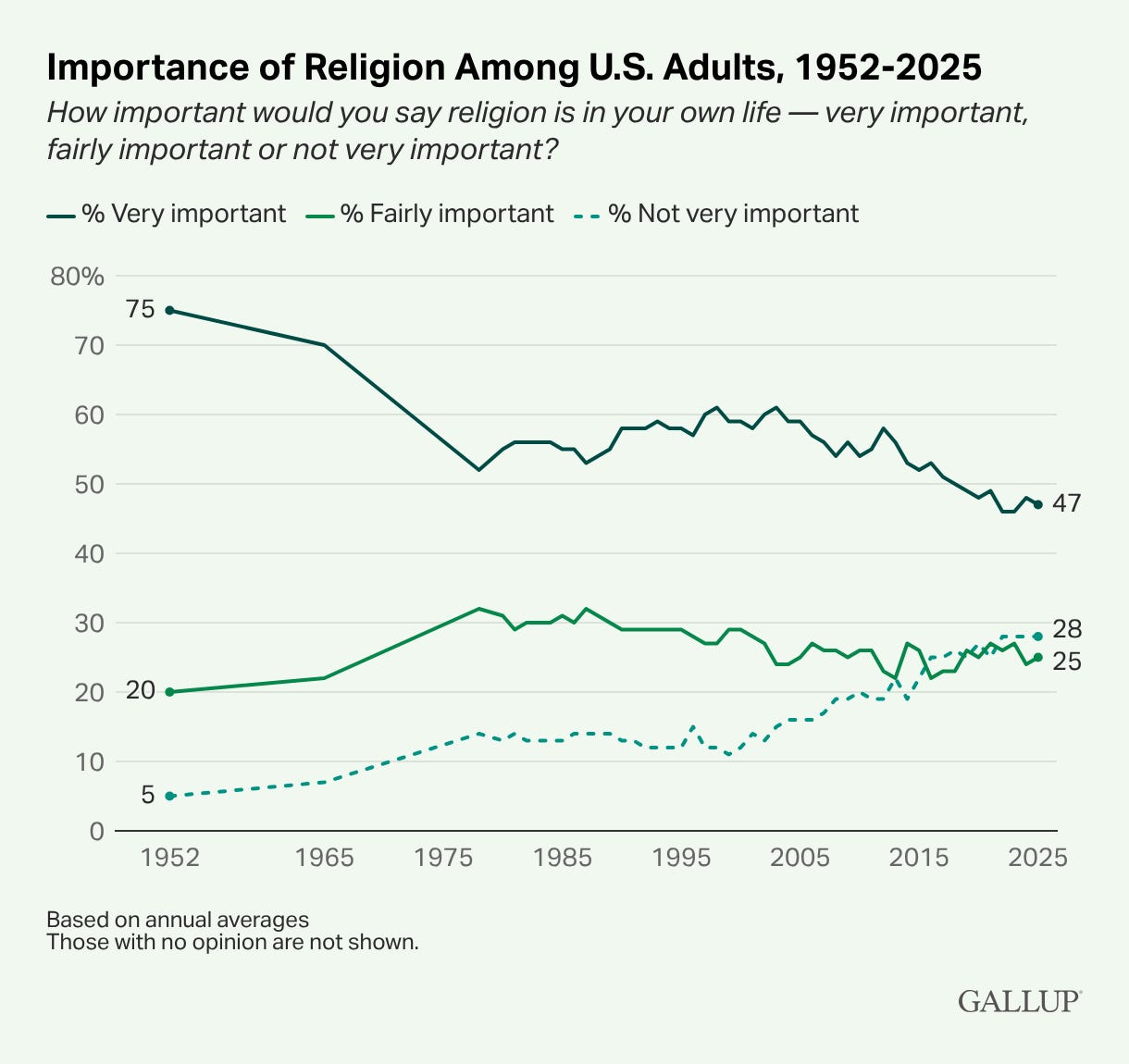
Almost 30 Percent of the population of the US identifies as having no religion.
The long-term decline in the Christian share of the population and growth of religious “nones” is demographically broad-based. There are fewer Christians and more “nones” among men and women; people in every racial and ethnic category; college graduates and those with less education; and residents of all major regions of the country.
Ryan Burge documents the decline in religion in his new book, The Vanishing Church.
Churches that occupy the middle space are quickly becoming few and far between. And there’s little reason to believe that the declines will slow down. According to their own records, half of the members of the Episcopal Church have celebrated their 65th birthday, while just 13 percent of members are under the age of eighteen.
Ben Crosby considers the decline in his mainline denomination, which is not unlike many other denominations.
I am thirty-two years old, and the church in which I am ordained, the Episcopal Church, has a mandatory retirement age of seventy-two, meaning that I have up to forty years of ministry ahead of me. I fully expect my denomination to be nearly unrecognizable at the time I reach retirement age. Our denomination is overwhelmingly old and white, and mostly made up of small churches in parts of the country that are not growing; our failures at evangelism and retaining the people born in our church mean that demographers predict that our numbers will hit zero around 2040.
“Spiritual but Not Religious”
While institutionalized religion is declining, spiritual belief of some kind remains:
86% believe people have a soul or spirit in addition to their physical body.
83% believe in God or a universal spirit.
79% believe there is something spiritual beyond the natural world, even if we can’t see it.
70% believe in an afterlife (heaven, hell or both).
Becoming the Creative Minority
Peter Mommsen introduces our new issue, After Religion:
Despite their demographic insignificance, [the first Christians] possessed a remarkable confidence. As Cardinal Joseph Ratzinger put it (borrowing a phase from Arnold Toynbee), they were a “creative minority,” whose power lay not in numbers but in their spiritual vitality and transformed lives….
Christians today, if demoralized, can take courage from these forerunners in the faith. Church decline and the de-Christianization of culture and social institutions are painful and, from a Christian perspective, plainly bad for human beings. But, according to our faith, they aren’t the end of the story. Today, as always, our vocation remains the same: to live already now as citizens of the New Jerusalem.
In her essay for After Relgion, Karen Kilby points beyond strategy for the church’s salvation:
It’s sad, dispiriting, and depressing at times to see diminishment in the churches around us. But sadness and bleakness can never be the whole story. We do what we have it in us to do, we appreciate and rejoice in the elements of new growth and possibility we can detect even in the midst of diminishment, and finally, we trust that the Holy Spirit will not abandon the church. We know that its ultimate future, together with the future of all things and all manner of things, does not depend on our own best analyses and strategies.
Ben Crosby also points towards hope:
I don’t know what my church body will look like when I retire, or how many of the congregations … will still exist. The scope of the crisis sometimes feels too heavy to bear. But Jesus makes it all worthwhile. Amidst the trials of ministry today, I have so many precious stories of God’s grace and power, tenderness and love, both in my life and in the lives of those I have served as pastor. Our God is good and he is faithful, even when we are faithless. To paraphrase the old hymn, his grace has brought his church this far and his grace will bring it home.
Also in our new issue, Galen Watts describes the work that being the “creative minority” takes. And it’s not a new struggle for Christians:
In the world we inhabit today, to live by the gospel requires principled conviction, concerted discipline, and purposeful community. In a sense, the task is much harder than it once was. And this is indeed a sobering thought. Yet it’s worth remembering that Christianity emerged into a world not unlike our own – where jealous gods warred for our attention and loyalty. Thus, in a deeper sense, it is no harder now than it ever was to walk in the footsteps of Jesus.
A pope and a prophet? Pope Benedict XVI acknowledges the problem of the decline of religion, but argues that a church of faith will emerge:
From the crisis of today, the Church of tomorrow will emerge – a Church that has lost much. She will become small and will have to start afresh more or less from the beginning….
In contrast to an earlier age, she will be seen much more as a voluntary society, entered only by free decision. As a smaller society, she will make much bigger demands on the initiative of her individual members….
But the Church will find her essence afresh and with full conviction in that which was always at her center: faith in the triune God, in Jesus Christ, the Son of God made man, in the presence of the Spirit until the end of the world…. I am certain about what will remain at the end: not the Church of the political cult but the Church of faith. She may well no longer be the dominant social power … but she will enjoy a fresh blossoming and be seen as man’s home, where he will find life and hope beyond death.1

Plough-Share
Christopher Zimmerman responds to King Ho Leung’s piece about Marx's critique of religion:
King-Ho Leung’s argument with Marx’s view of religion is the predictable one; like most, it repeats part of the latter’s most famous utterance – that religion is “the opiate of the people” – but takes it out of context by ignoring the important sentence that precedes it in which Marx acknowledges that it is “the sigh of the oppressed creature, the heart of a heartless world, and the soul of soulless conditions.” Marx’s critique is not so much anti-theistic as anti-illusory; he goes on to aver that to the extent religion provides illusory happiness, it will eventually awaken the demand for real happiness. His point is well made. And well taken: given the historical state-sanctioned christianization of capitalism by the institutional church, it is hardly surprising that so many seekers for truth have grown disenchanted with (and often denounced) both down through the centuries out of a desire to better follow Christ.
Do you have any comments or questions – or new possibilities? Send them our way:
Till next week!
Joseph Ratzinger, Faith and the Future, (Ignatius Press, 2019), 116-118.
I am sorry that Christopher Zimmerman found my contribution to Plough so inadequate! I wouldn't say that my article is about Marx—much less an argument with him. The tagline about Marx was added without my knowledge (I actually proposed other ones).
I'd also like to note that in my original submission, I actually quoted the very lines that Christopher Zimmerman mentioned but they were edited out (please see below). I'd also think that my article speaks to Marx 's critique of Christianity as being "anti-illusory" too, though perhaps not articulated cleary enough for Mr Zimmerman. I am sorry that my piece offended him so much! I will bear his comments in mind should I have any future involvement with Plough.
But, for reference, here is the original introductory paragraph I submitted to Plough on 14 Oct 2025:
“The critique of religion is the prerequisite of all critique.”
So wrote Karl Marx in the opening line of his Critique of Hegel’s Philosophy of Right. Very broadly speaking, in Marx’s view, “religion” is an oppressive form of ideology which upholds the economic structures of the status quo. Religious ideology seeks to keep the wealthy wealthy and the poor poor: it tells you that your treasures and ultimate values are in some place called “heaven”, so you don’t have to worry about economic inequality or poverty under the conditions of capitalism or feudalism. Poor people will be okay: God will take care of them when they get to heaven. Religion must thus be critiqued if one is to undertake any critique of capitalist society and its ideological assumptions. This is why Marx believes the critique of religion must be “the prerequisite of all critique”. For religion, as Marx writes later in the same text, “is the sigh of the oppressed creature, the heart of a heartless world, and the soul of soulless conditions. It is the opium of the people.”
I appreciate the opportunity to respond and connection with you. The comment from Benedict was telling and I believe true. Jesus referred to the disciples as a little flock. To that small group He said the kingdom would be given. Our institutions are temporary. I think they are more temporary within our own lives. We ought not despair over "membership" declines for many turned away from following Christ Jesus fully. I have been near despair as I struggle through my own weaknesses yet i cannot deny the One who redeemed me and gave all that I might live to serve Him and others. The power to be witnesses of Christ while in this world is the same as it was in the upper room. It is all by the Spirit. It will look small to us but the Lord has scattered a multitude of us as seed across the earth. May our roots be and go deeper in the Lamb of God who alone is the source of spiritual life. Jesus is our life.